


Capital Advisory
Why cost consciousness now?
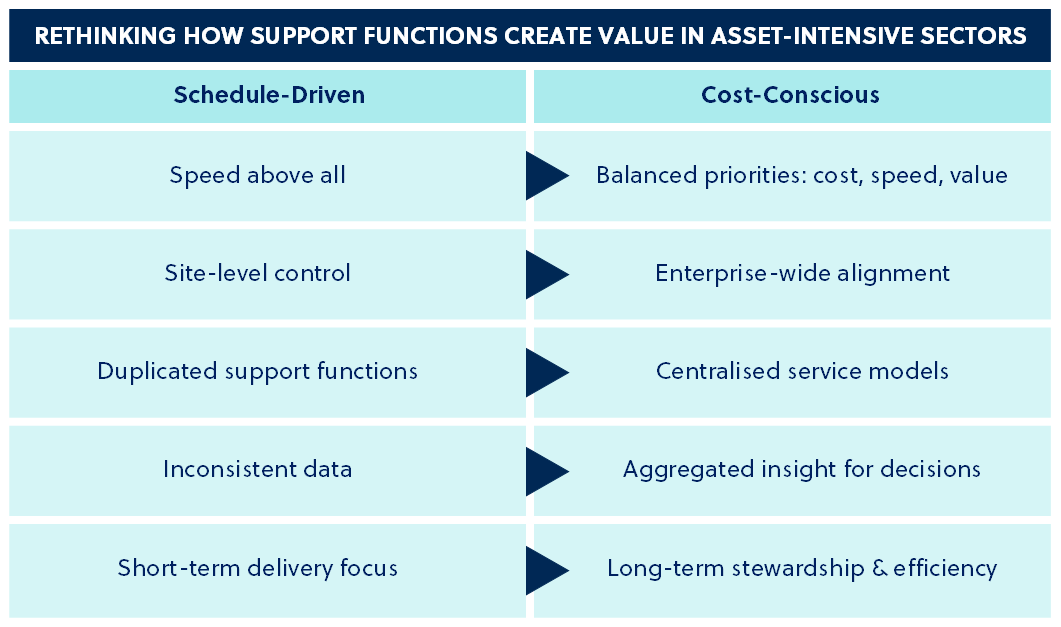
In Australia’s evolving political and economic climate—marked by changing governments, growing fiscal restraint, and rising delivery expectations—the pressure on large-scale capital and infrastructure projects is intensifying. The energy transition, in particular, is revealing a critical pivot: the dominant priority of speed-to-delivery is giving way to a more balanced focus that includes cost, capability, and long-term efficiency.
As projects grow in scale and complexity, the question is no longer just how fast can we deliver, but how wisely are we operating? Increasingly, organisations must demonstrate not just urgency, but stewardship.
A shift in how support functions create value
In this environment, operating models built on decentralised and often duplicated support functions are becoming unsustainable. Forward-looking organisations are turning to centralised service delivery models—often referred to as shared or enterprise services—not simply to cut costs, but to improve consistency, transparency, and strategic alignment.
In asset-intensive sectors such as energy, mining, utilities, and heavy industry, these models consolidate functions like HR, finance, procurement, and supply chain into coordinated hubs that serve the enterprise. The result: reduced overheads, clearer accountability, and smarter use of skilled or scarce resources across the business.
Beyond cost: unlocking insight and improving decisions
Yes, these models save money—but the more powerful benefit is the access to better information. Aggregated data from across the enterprise enables more accurate performance analysis, risk forecasting, and capital allocation. For leaders managing billions in asset value and navigating volatility in supply chains and markets, this level of insight is a competitive advantage.
Centralised procurement, for example, brings stronger commercial discipline, better supplier leverage, and tighter compliance. Financial and operational standardisation reduces the “noise” of inconsistent reporting, allowing leaders to focus on high-value decisions.
Enabling a culture of cost consciousness
Crucially, this is not about indiscriminate cost-cutting. It’s about embedding a culture of continuous cost consciousness—a mindset that values long-term efficiency, data-driven decision-making, and resource stewardship. This shift requires more than structure; it demands clear governance, digital enablement, and cultural change.
Digital tools like ERP platforms, AI-enabled analytics, and automation support speed and scale—but human factors matter too. Change management is essential to move from siloed, site-level control to enterprise-wide performance culture.
Relevant for public sector agencies, too
While often associated with the private sector, these approaches are increasingly relevant for public agencies responsible for infrastructure, energy, or service delivery. With rising demands for transparency, accountability, and fiscal discipline, centralising and professionalising support functions is one lever governments can pull to enhance delivery without increasing costs.
Efficiency as a strategic lever
As Australia enters a new chapter in its energy and infrastructure story, the organisations that thrive will be those that treat efficiency not as a back-office metric, but as a strategic lever. Centralised support models—when designed thoughtfully—can transform service functions from necessary costs into value-creating enablers of strategic delivery.
Where in your organisation could a shift from schedule-driven urgency to cost-conscious design unlock not just savings, but better outcomes? Is it time to revisit or refresh your approach to corporate support? Reach out to Rennie’s Business Advisory team for insights to how we are creating value for our clients.