
Capital Advisory
The challenge:
Decarbonisation modelling and planning in the transports and logistics space
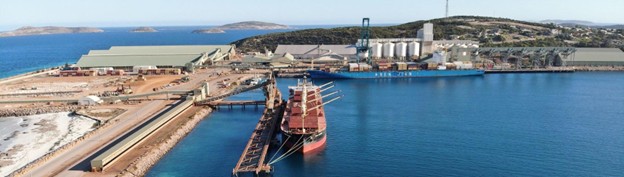
The client engaged Rennie to develop a decarbonisation roadmap that would be fit-for-purpose for meeting WA Government requirements as a Government Trading Enterprise. The group of three ports needed an evidence informed plan with associated business case elements, and which could resonate with a range of internal and external stakeholders.
Our solution
Decarbonisation modelling
Rennie built an interactive scope 1 and 2 emissions model, designed to be able to be used by the client to test different decarbonisation projects and initiatives and compare quantitative and qualitative factors. The model included a range of project and macro scenario related variables, and included a range of opportunities ideated by the client’s staff and researched from like organisations – scoring each against weighted qualitative criteria and financial and emissions related metrics.
Scenario analysis and sensitivity testing
As this client’s emissions are heavily influenced by trade and different grid transition rates, the different decarbonisation pathways were tested for sensitivity against different macro scenarios. These scenarios included different trade outlooks at each port, different climate regulations, and different grid decarbonisation rates.
The client’s leadership spent time agreeing on the most likely scenario, and an alternate plausible scenario that represented a higher risk to the business. A roadmap report was delivered that assessed different options against each of these scenarios, providing leadership with a clear view set of potential outcomes and impacts to inform decision making on decarbonisation efforts into the medium term.
Our impact
Laying out decarbonisation pathways against different macro scenarios provided leadership with a clearer view of their climate risks and the tradeoffs of their decisions.
Decarbonisation efforts don’t occur in a vacuum – as with any business decision, they inform and are informed by what is happening in the business, and is often influenced by the broader economy and regulatory environment.
A key impact of this work was showing that a significant energy-related capital investment could be delayed until external conditions had changed, with no negative impact on emissions. It also meant that informed decisions could be made at the asset and site level – for example, the transition timing and pathway for front end loaders and other vehicles would be different at each site, with renewable diesel and electrification levers being used at different timings depending on anticipated grid electrification rates and the asset renewal schedules.
Most importantly, the work highlighted the importance of robust climate risk analysis in whole of business decisions and investments. The ask of this work was centered on providing a roadmap for decarbonisation, but the greatest value came from the consideration of what different internal and external economic and regulatory factors could affect the client’s climate risk exposure. Strategy and risk/opportunity analysis are interrelated in business, and is no different when addressing climate change.
Key insights
- Decarbonisation planning needs to be done in conjunction with whole of business planning to have the greatest chance of success and impact.
- Scenario analysis is a useful tool to stress test different assumptions.
- Involving operational staff in ideating potential decarbonisation projects is important in creating buy-in.